
Prologue
Brigid of Kildare is a complex and elusive figure. She is viewed as sacred and meaningful to both Christians, especially Irish Catholics and practitioners of Celtic Christianity, and Pagans, especially Celtic pagans, Druids, and Witches. She is venerated as a Christian saint, worshipped as a manifestation of a Celtic goddess, and often understood in a syncretic combination of the two. Also, as the patron saint of Ireland, she is a powerful representation of national and ethnic identity for Irish people across the world.
These multiple traditions can work together or stand in opposition to one another, depending who you ask, but there is one fact about Brigid that no one can deny: she is a part of Living Religion, constructed and understood in a truly multivocal space. The purpose of this article is to explore the connection between Brigid the saint and Brigid the goddess. Is there such a connection, or is it a modern invention? More importantly, how do our modern conceptions of her serve our needs today?
Saint Brigid and Hagiography
Our first stories of Saint Brigid come from hagiographical texts. Hagiography is a genre of sacred story that recounts the biography of a saint, martyr, or other venerated figure. In Christianity, these stories often include the recounting of miracles performed by the saint, who is usually connected to a specific monastery or region. The saint’s cult is promoted by the monastery they are connected to, both through hagiography and the display of physical relics, in order to gain prominence and power. In Brigid’s case, this would be the monastery at Kildare, which she is said to have founded. The most well-known hagiography, as well as the earliest, was written by Cogitosus, a cleric at Kildare, in the seventh century, over a hundred years after Brigid’s life (Kissane 113). At this point, Brigid’s cult was likely well established and legends about her were being passed down through oral tradition. Cogitosus’ account compiles various miracles together into one narrative as he aims to codify Kildare’s importance and honor a figure within his Irish Catholic tradition.

According to Cogitosus, Brigid was born to Christian parents named Dubhtach and Broicsech and demonstrated a virtuous character from childhood. Her first miracle occurs when she is sent by her mother to churn butter for the household, and chooses to distribute it all to the guests and the poor instead. Fearing her mother’s retribution, she prays to God for assistance, and he restores an even greater amount of butter to her. This gift becomes the physical evidence of the depth of her faith, which the community marvels at. Later, when her parents wish to betroth her to a man, she goes to the bishop and takes her holy vows. As she is kneeling before the altar, her hand touches the wooden base, which turns green and fresh as if it had never been cut down and stripped of bark (Kissane 273). These are just a couple of the miracles Cogitosus describes, and while much of his account follows typical hagiographical tropes (like the virgin escaping a betrothal forced upon her by her parents), we can already see a distinct theme emerging— Brigid has a unique connection with and power over nature, especially dairy animals and other agricultural aspects. In fact, out of the thirty-two miracles described, at least fourteen directly involve livestock, grain, or other things associated with agriculture.
Saint Brigid and Folklore
This focus on cattle and agriculture continues to be reflected in the common folklore surrounding Brigid. While Cogitosus is writing within a specific genre and is explicitly telling Brigid’s story to demonstrate the glory of the Catholic Church and the monastery at Kildare, the practices and oral traditions of Irish people reach beyond his account. For example, Cogitosus mentions that Brigid’s feast day falls on February 1st, but he does not expand upon any specifics of the celebration. However, over a thousand years later in 1942, the Irish Folklore Commission carried out a survey centered entirely around St. Brigid, directing informants from all 32 counties of Ireland to fill out a questionnaire describing the customs surrounding her, especially those related to her feast day.

These customs are rich, varied, and fascinating. For the feast itself, “butter [is] regarded as an essential ingredient”, reflecting Brigid’s miracles with dairy and cattle (Kissane 255). After the feast, the family weaves St. Brigid’s crosses out of rushes, straw, and small pieces of wood. The crosses come in a variety of shapes, and are believed to provide protection over the household. Often, the crosses are also placed with farm animals, especially the cattle, where there are reports of them curing milk fever and other ailments (Kissane 262).

Unfortunately by 1942, many of the described customs had fallen out of practice due to “modernization”, and many informants were relying on the testimony and memory of elderly people within their communities, who would have participated in the customs in their youth. Clearly, things will have necessarily changed going into the 21st century.
Brigid the Goddess
Alongside the tradition of St. Brigid, there is the tradition of the goddess Brigid, who would have been worshipped in Ireland prior to Christianization. She is first mentioned in Cormac’s Glossary, a tenth century text likely written by an Irish bishop. Here, Brigid is defined as the goddess of poetry, healing, and smithcraft, and as having a triple aspect (Cormac). Other mythological scraps position her as a matriarchal deity that is intimately connected to the land (Berger). On the surface, the goddess Brigid appears to have been superseded by her saintly counterpart, but many scholars argue that aspects of Brigid’s identity and sacred practices were carried over into the saint’s cult, which could explain both Brigid’s unique connection to nature and the date of her feast.

In 1985, Pamela Berger published her seminal work, “The Goddess Obscured: Transformation of the Grain Protectress from Goddess to Saint”. Here, she places Brigid into a larger pattern of female goddess figures related to fertility and agricultural growth. She begins her argument by pointing out that February 1st was also a significant date in pre-Christian Ireland, as it marked the start of spring and the festival of Imbolc, when farmers would break through the sod with a spade, symbolically beginning the plowing and sowing season. Additionally, the word Imbolc itself literally means “around the belly”, possibly alluding to the fertility aspect of the festival, where the archetypal female grain goddess becomes pregnant with that years’ crop. Berger theorizes that the St. Brigid’s Cross was carried over from Imbolc traditions, as straw and grain from the previous year are used to construct the cross, which is said to have protective qualities. Kissane also believes the crosses to have pre-Christian origin due to their unusual shape, which may have originally been a representation of the sun, which is “the ultimate source of fertility”(259).
“But!”, you may be thinking, “Brigid is associated with dairy animals far more than she is with grain!”. And you would be right! However, Berger points out that while the folk customs associated with seeding and tillage have been retained, the Irish economy eventually became centered on sheep and cattle. Imbolc was then transformed into a holiday focused on the lactation of ewes and cows (73). If Brigid is a matriarchal deity, associated with the fecundity of the land and animals, and these aspects were celebrated during the Imbolc festival, it is probably no accident that Saint Brigid, who is also associated with the land and animals, is celebrated on February 1st. Although the extent and depth of the connection between them has been lost to time, a connection probably exists.
Modern Practices
Earlier, I mentioned that things will have necessarily changed going into the 21st century for those who venerate Brigid. The waning of traditional practices associated with the saint and the efforts of scholars to connect the saint and the goddess in the 20th century have led to new practices and beliefs, which are often syncretic. In modern syncretic practice, people often pick and choose from different traditions and stories surrounding Brigid, building their own understanding of her based upon their needs and what they identify with.
Often, this multivocality gives those outside of the dominant culture a place of safety and belonging. In Alberta, Canada, a community of Roman Catholic Women Priests hails St. Brigid as the namesake of their church, hearkening back to some legends that Brigid was a bishop and therefore legitimizing their claim to spiritual power through the priesthood.
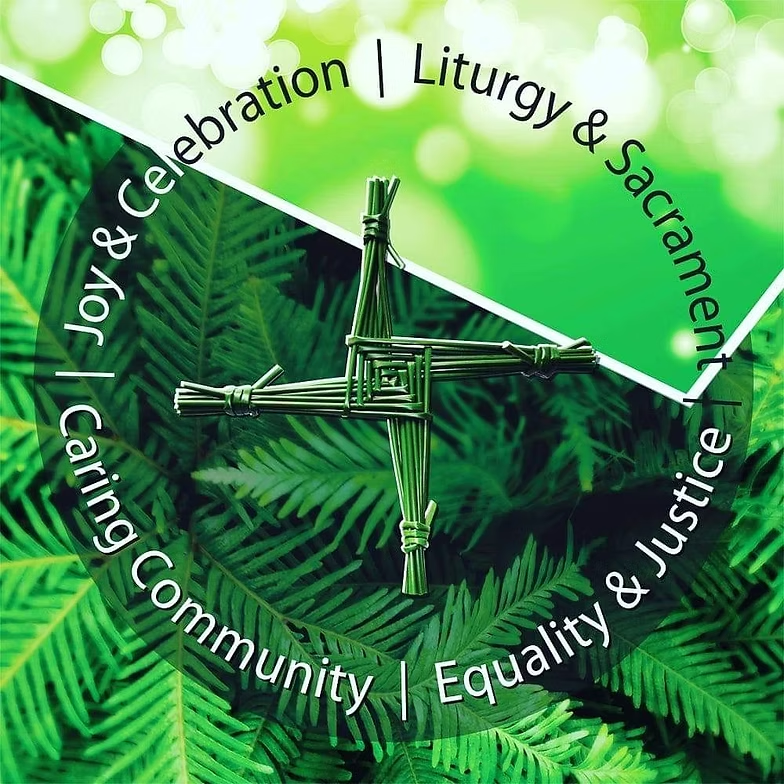
Meanwhile, in New South Wales, Australia, a community of self-described neo-Pagans gather weekly for traditional Irish dance classes, with the goal of honoring the goddess Brigid through music, bodily movements, and community connection. Both of these communities are thousands of miles from Ireland, yet they find deep meaning in Brigid’s sacred stories.
Conclusions and Considerations
Amy Panetta, a practitioner of Celtic Christianity and spirituality and a scholar of Brigid, writes:
“For so many people, the stories of St. Brigid have brought them so much comfort, especially in the qualities of hospitality, generosity, and compassion that she possesses. St. Brigid has been referred to by the Brigidines as a “bridge” — a bridge between the pagan and the Christian, as well as other divergent ideologies, as well as to bring people together and work towards healing and peace.”
What this quote illuminates is that, the veracity of the connection between goddess and saint aside, our popular interpretation of Brigid as a complex and syncretic figure speaks to the age we live in, where truth is “produced and sustained by multiplicity, ambivalence, by ambiguity” (Walker). It is precisely this ambiguity, diversity, and harmony that makes Brigid, in her many forms, so attractive, so meaningful, and so impactful to so many different communities around the world.
Positionality and Process
I have approached Brigid of Kildare as an outsider to the tradition. I am not Catholic, Celtic Christian, or Neopagan, like the folks whose testimonies I included at the end of this article, and I cannot say that Brigid holds any significance in my personal sacred practices or spirituality. However, I have always admired her and the stories about her, and have always found her unique position as a syncretic figure interesting. I started researching her because I wanted to see if the connections between goddess and saint were logically supported. However, by the end of my process, I found that that question did not really matter to me anymore, at least as it pertains to people’s modern practices. Whether or not something is literally true has very little bearing on whether it is meaningful to people. And if people find meaning in connecting St. Brigid and the goddess Brigid, the connection exists and is really real, regardless of its historicity. I think this was a valuable lesson for me to learn. Additionally, finding that the connection is supported by research also taught me to appreciate the endurance and flexibility of stories which must transform to fit a new dominant culture. I hope to explore this further in future work!
Works Cited
Works Cited
Berger, Pamela. The Goddess Obscured: Transformation of the Grain Protectress from Goddess to Saint. Beacon Press, 1985.
Cormac. “Sanas Chormiac. Cormac’s Glossary.” Internet Archive, https://archive.org/details/cu31924071173474/page/n37/mode/2up. Accessed 2 March 2026.
Kissane, Noel. Saint Brigid of Kildare: Life, Legend, and Cult. Four Courts Press, 2017.
Panetta, Amy. “Brigid: Goddess, Saint, and Bridge.” New Eden Ministry, https://newedenministry.com/2019/09/01/brigid-goddess-saint-and-bridge/. Accessed 2 March 2026.
Saint Brigid Of Kildare: Catholic Faith Community, Calgary Alberta. https://www.saintbrigids.org/. Accessed 2 March 2026.
Walker, Stephanie Kirkwood. “Brigit of Kildare as She is: A Study of Biographical Image.” Biography, vol. 17, no. 2, 1994.